
A1–A2 Spanish grammar resource

Complete Spanish present tense guide

This guide helps you master the core uses of the Spanish present tense, including regular verbs, stem-changing verbs, irregular yo forms, high-frequency irregular verbs, and pronominal verbs. Whether you are starting at A1 or reviewing A2 foundations, you will find clear tables, practical examples, common mistakes, exercises, and a quiz to help you use the present tense with confidence.

Complete Spanish present tense guide hero image
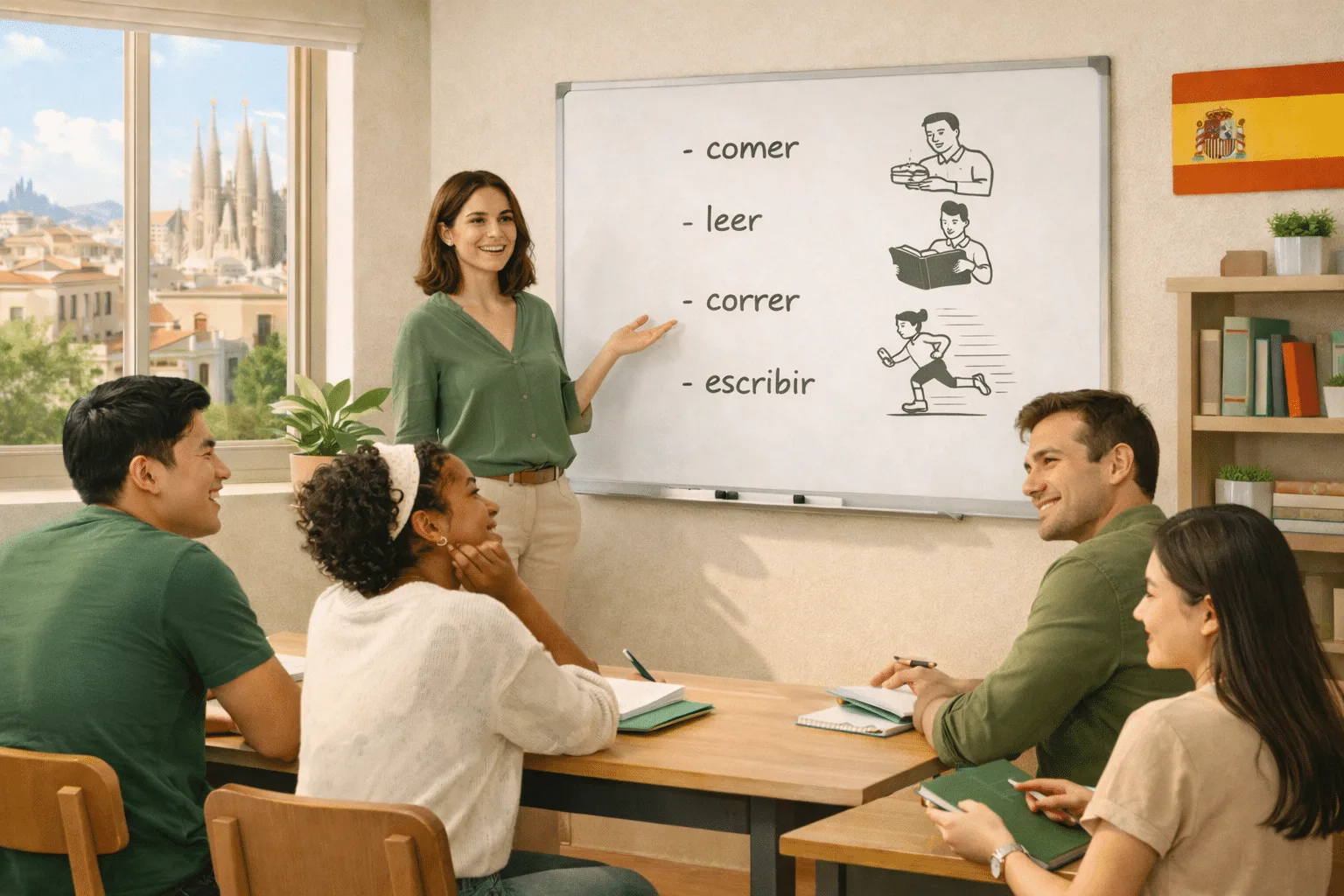
Classroom situations for learning Spanish present tense and verb conjugations
A1–A2 Grammar Resources|SoulTripAdventure
Spanish Present Tense Guide: Regular and Irregular Verbs Made Clear

This guide takes you through the core uses of the Spanish present tense (presente de indicativo), including regular verbs, stem-changing verbs, irregular yo forms, very high-frequency irregular verbs, and pronominal verbs. Whether you are starting at A1 or reviewing A2 grammar, you will find clear tables, useful examples, common mistakes, exercises, and a quiz to help you actually use the present tense with more confidence.

A1 essentials A2 review Regular verbs Irregular verbs Examples and practice

Overview

1) What is the Spanish present tense and when do we use it?

The Spanish present tense (presente de indicativo) is one of the most important and most frequently used tenses. It does not only describe what is happening right now; it is also used for daily habits, general facts, preferences and opinions, timetables or opening hours, and even some future events that are already arranged.

The core idea behind the present tense

  • Express what is happening now: Ahora estudio español.
  • Express daily routines: Siempre desayuno a las siete.
  • Express general facts: Madrid está en España.
  • Express preferences and opinions: Me gusta la música.
  • Express fixed schedules or arrangements: La clase empieza a las nueve.

Why is the present tense particularly important for learners?

Because you will use it constantly in basic communication. Introducing yourself, describing your routine, talking about preferences, asking what someone does, or explaining today’s plans all depend heavily on the present tense.

Think of the present tense as the foundation of everyday Spanish: once you control it well, the rest of the verb system becomes much easier to learn.
A1 core

Start by mastering regular verb conjugations so you can talk about your daily life, interests, nationality, job, and simple facts.

A2 extension

Become familiar with common irregular verbs, stem-change verbs, and naturally use the present tense in more complete sentences.

Most common use cases

Self-introduction, school life, work content, time schedule, family and interests, daily Q&A.

Remember this judgment method first

If what you want to express is a current situation, something that happens regularly, a general fact, or a fixed arrangement, in many cases the Spanish present tense is the first option you should consider.

Regular Verbs

2) Basic changes in the present tense: How to change regular verbs?

In Spanish, the base form of a verb is called the infinitive (infinitivo). It usually ends in -ar, -er, or -ir, for example hablar, comer, and vivir. The basic process for forming the present tense is simple: remove the infinitive ending, keep the stem, and add the correct ending for the subject.

Basic steps for change

Step 1:Find the infinitive, for example hablar.
Step 2:Remove -ar, -er, or -ir to get the stem.
Step 3:Add the corresponding suffix according to the subject word (yo / tú / él...).
Step 4:Note that different types of verbs have different endings.

Let’s look at the simplest example first

For examplehablar(say):

  • The stem is:habl-
  • yo hablo
  • tú hablas
  • ella habla
Just see first that the verb belongs to-ar-erstill-ir, You can conjure most regular verbs first.

Summary list of present tense suffixes of regular verbs

personal name -ar -er -ir
yo -o -o -o
you -as -es -es
he/she/you -a -e -e
we -amos -emos -imos
you -áis -éis -ís
they / them / you -an -en -en
hablar(-ar)
  • yo hablo
  • tú hablas
  • él / ella habla
  • nosotros hablamos
  • vosotros habláis
  • ellos hablan
comer(-is)
  • yo como
  • tú comes
  • él / ella come
  • nosotros comemos
  • vosotros coméis
  • ellos comen
vivir(-and)
  • yo vivo
  • tú vives
  • él / ella vive
  • nosotros vivimos
  • vosotros vivís
  • ellos viven

Example: Put regular verbs into real sentences

  • Yo hablo español con mi profesora.I speak Spanish to the teacher.
  • Nosotros comemos en casa.We eat at home.
  • Ella vive en Valencia.She lives in Valencia.
  • Vosotros estudiáis mucho.You read a lot of books.

The most common areas of confusion for beginners

Don't confuse -er with -ir for nosotros.

  • comemos
  • vivimos
  • vivemos
Memory skills:-arlooks most likeaseries,-erand-irIt's very similar to most people, butwe / youIt's easiest to see the difference.

Stem-Changing Verbs

3) Stem-changing verbs: Why do some present tenses seem "irregular"?

Some Spanish verbs in the present tense do not only change their endings: they also change the vowel inside the stem. These are usually called stem-changing verbs. For beginners, the key is not to memorise every verb at once, but to understand which vowel changes, what it changes into, which persons change, and which ones stay the same.

The most common pattern is this: yo, tú, él / ella / usted and ellos / ellas / ustedes usually change, while nosotros and vosotros usually keep the original stem.

Remember this core concept first

Step 1:First remove the verb ending and look at the stem.
Step 2:Check whether the vowel in the stem is a common variation type.
Step 3:In most cases, nosotros and vosotros do not change the stem.
Step 4:Even when the stem changes, the regular -ar, -er or -ir endings still apply.

The most likely place to go wrong

Many students mistakenly apply the stem change to every person, but that is usually incorrect.
  • yo pienso
  • nosotros pensamos
  • nosotros piensamos
Memory Tip: Pay special attention when you see stem-changing verbswe / you, because they often retain the original vowels.
e → i.e

This is the most common group. in the stemebecomeie

  • pensarpienso,piensas,piensa,pensamos,pensáis,piensan
  • quererquiero,quieres,quiere,queremos,queréis,quieren
  • entenderentiendo,entiendes,entiende,entendemos,entendéis,entienden
o → eu

in the stemobecomeue, also a UHF type.

  • poderpuedo,puedes,puede,podemos,podéis,pueden
  • volvervuelvo,vuelves,vuelve,volvemos,volvéis,vuelven
  • dormirduermo,duermes,duerme,dormimos,dormís,duermen
and → i

This group is more common in-irverb, in stemebecomei

  • pedirpido,pides,pide,pedimos,pedís,piden
  • seguirsigo,sigues,sigue,seguimos,seguís,siguen
  • repetirrepito,repites,repite,repetimos,repetís,repiten
u → ue

This group is relatively small, but very common representative verbs arejugar

  • jugarjuego,juegas,juega,jugamos,jugáis,juegan
Although it is not e→ie or o→ue, the notation is very similar: also most personal changes,nosotros / vosotrosconstant.

Understand at a glance: Which pronouns will change?

type yo you he/she/you us you they / them / you
pensar(e→ie) pienso piensas piensa pensamos pensáis piensan
poder(o→ue) puedo puedes puede podemos podéis pueden
pedir(e→i) pido pides pide pedimos pedís piden
jugar(u→ue) juego juegas juega jugamos jugáis juegan

Example: How would it really be used?

  • Yo quiero aprender español.I want to learn Spanish.
  • Ella entiende muy bien la gramática.She knows grammar well.
  • Nosotros podemos ir mañana.We can go tomorrow.
  • Ellos piden café.They order coffee.
  • Mis amigos juegan al fútbol.My friend plays football.

The most important summary

Stem-change verbs do not change for every person.

Remember the high frequency mode first:yo / tú / él / ellosChanging often,nosotros / vosotrosAlways maintain the original shape.

Irregular Yo Forms

4) only inyoIrregular verbs: Which ones must be learned frequently?

Some verbs are in the present tense onlyyoThe form of the pronoun is irregular, while other pronouns roughly follow the original change rules. This type of verb is very important for beginners because they occur very frequently in everyday Spanish, e.g.hacersalirponersaberverdarwait.

Learning tips: Don’t memorize a long list at once. You can presschanging patternto remember, for example-go-zco-igowait.

Why is this category particularly important?

  • Many are very high-frequency verbs.
  • They often appear in self-introductions, daily conversations and spoken expressions.
  • It is easiest for students toyoForm error.
  • Memorizing a few common patterns will be more efficient than memorizing them one by one.

Remember this concept first

Don't think that all irregular verbs are "messy with every person". Some verbs are actually justyoIn particular, the remaining persons are still relatively regular.
So when you see irregular verbs, ask yourself:Is it all irregular or justyoirregular?
-gotype
  • hacer → hago
  • poner → pongo
  • salir → salgo
  • tener → tengo
  • venir → vengo
  • traer → traigo
  • oír → oigo
-zcotype
  • conocer → conozco
  • parecer → parezco
  • conducir → conduzco
  • traducir → traduzco
  • producir → produzco
Other common special forms
  • saber → sé
  • ver → veo
  • dar → doy
  • caber → quepo
  • caer → caigo

Understand at a glance: high frequencyyoList of irregular verbs

Original form yo Are there general rules for other pronouns? Remark
hacer hago yes haces, hace, hacemos...
poner pongo yes Commonly used for placing, setting, displaying
salir salgo yes means to go out, set off, leave
saber yes Note that it is notsabo
ver veo yes very high frequency
dar doy yes Note that it is notdao
conocer conozco yes Get to know people/familiar places
traer traigo yes Often appears together with bringing something and bringing something
caer caigo yes Indicates falling
caber quepo yes It means to be able to tolerate and put in

Example: The most common real usage

  • Yo hago la tarea por la noche.I do my homework at night.
  • Yo salgo de casa a las ocho.I go out at eight o'clock.
  • Yo pongo la mesa.I set the table.
  • Yo sé la respuesta.I know the answer.
  • Yo veo una película.I watch a movie.
  • Yo conozco a tu profesora.I know your teacher.

Common mistakes for beginners

  • yo haco→ ✅yo hago
  • yo sabo→ ✅yo sé
  • yo conozo→ ✅yo conozco
  • yo salo→ ✅yo salgo

The safest approach is to replace these high-frequency verbs withyoRemember the form as a fixed combination first, Then gradually become familiar with their types and patterns.

Highly Irregular Verbs

5) High-frequency super-irregular verbs: the most important group in the present tense

Some verbs not only change slightly in the present tense, but appear simultaneouslyspecial suffixStem changes, Even the entire form is very different from regular verbs. Although these verbs seem difficult, But they are very common in daily Spanish, so they are core content that must be familiar with in advance.

The most important way to learn is not to memorize the entire list at once, but to grasp it firstThe most frequent and commonly used verbs, and then put it into real sentences and use it repeatedly.

Why must this group of verbs be learned first?

  • ser: Introduce identity, nationality, occupation, characteristics
  • ir: Expressing going to a certain place, moving, arranging
  • haber:usehaymeans "yes"
  • tener: Express possession, age, feelings
  • venir:Expression comes from, where does it come from
  • decir: to express, tell, express

Be mentally prepared first

These verbs usually cannot be guessed just by "regular endings", and many forms must be directly familiar.
But the good news is: they're really high frequency. The sooner you learn it, the sooner you can express yourself authentically in Spanish.
ser
  • yo soy
  • tú eres
  • él / ella es
  • nosotros somos
  • vosotros sois
  • ellos son

Used to express identity, nationality, occupation, and characteristics.

ir
  • yo voy
  • tú vas
  • él / ella va
  • nosotros vamos
  • vosotros vais
  • ellos van

Used to express going to a certain place, setting off, and making arrangements.

haberhay
  • Hay un libro en la mesa.
  • Hay muchas personas aquí.

The most important thing about the present tense is the impersonal formhay, meaning "have".

tener/venir
  • tenertengo, tienes, tiene, tenemos, tenéis, tienen
  • venirvengo, vienes, viene, venimos, venís, vienen
These two verbs are typical "yoIrregular + stem change" mixed type.
decir/oír/oler
  • decirdigo, dices, dice, decimos, decís, dicen
  • oíroigo, oyes, oye, oímos, oís, oyen
  • olerhuelo, hueles, huele, olemos, oléis, huelen
Each of these verbs has special changes, which are high-frequency but require individual familiarity.

Understand at a glance: General list of high-frequency super-irregular verbs

verb Present tense focus form Key points
ser soy, eres, es, somos, sois, son Identity, characteristics, nationality, occupation
ir voy, vas, va, vamos, vais, van go somewhere, move, arrange
haber hay Express "have"
tener tengo, tienes, tiene, tenemos, tenéis, tienen yoirregular + e→ie
venir vengo, vienes, viene, venimos, venís, vienen yoirregular + e→ie
decir digo, dices, dice, decimos, decís, dicen yoirregular + e→i
oír oigo, oyes, oye, oímos, oís, oyen Noticeychange
oler huelo, hueles, huele, olemos, oléis, huelen Belongs to o→ue type, but the form is very eye-catching

Example: How are these verbs most commonly used?

  • Yo soy de Taiwán.I'm from Taiwan.
  • Nosotros vamos al centro.We go to the city center.
  • Hay una farmacia cerca.There is a pharmacy nearby.
  • Ella tiene veinte años.She is twenty years old.
  • Mi profesor viene de Madrid.My teacher is from Madrid.
  • Yo digo la verdad.I tell the truth.
  • No oigo bien.I can't hear clearly.

The most confusing point

  • ❌ handlehaberI memorized it as a complete list of persons, but I don’t know how to use it.hay
  • ❌ handleserandirmixed together
  • ❌ is written asyo decoyo tenoyo veno

A practical way to learn this group is to treat it as a high-frequency core set: ser, ir, hay, tener, venir, and decir.

Pronominal Verbs

6) Pronoun verbs: How to match them in the present tenseme / te / se

In Spanish, there is a common class of verbs that appear together with pronouns, such asllamarselevantarsedespertarseacostarsevestirse. These verbs are usually called pronominal verbs (verbos pronominales). For beginners, the key is to remember two things: the verb conjugates, and the pronoun also changes with the subject.

Pronoun comparison table

subject pronoun Example(llamarse)
yo me me llamo
you te te llamas
he/she/you se se llama
we nos nos llamamos
you os os llamáis
they / them / you se se llaman

Remember this basic formula first

Step 1:First decide who the subject is.
Step 2:Choose the right pronoun:me / te / se / nos / os / se
Step 3:Then change the verb into the present tense.
Step 4:Pronouns usually go before conjugative verbs.
So likellamarsenot just becomellamo, But to sayme llamo
llamarse
  • me llamo
  • te llamas
  • se llama
  • nos llamamos
  • os llamáis
  • se llaman

It is most commonly used to introduce yourself and ask for your name.

levantarse
  • me levanto
  • te levantas
  • se levanta
  • nos levantamos
  • os levantáis
  • se levantan

Often used to describe getting up or getting up.

vestirse
  • me visto
  • te vistes
  • se viste
  • nos vestimos
  • os vestís
  • se visten

This verb is both a pronoun verb and a stem-changing verb.

Common life examples

  • Me llamo Ana.My name is Ana.
  • Nos levantamos a las siete.We get up at seven o'clock.
  • Él se acuesta tarde.He goes to bed very late.
  • Yo me visto rápido.I dress quickly.
  • ¿Cómo te llamas?May I have your name?
  • Ella se despierta temprano.She wakes up early.

The most common mistakes beginners make

  • llamo Ana→ ✅me llamo Ana
  • yo levanto a las siete→ ✅me levanto a las siete
  • se vestimos→ ✅nos vestimos
  • ❌ Forget the pronoun position and writellamo me

The most practical notation is:Look at the subject first, then choose the pronoun, and finally change the verb.

Many high-frequency verbs describing daily routines are pronoun verbs, so if you want to talk about your living habits, This group must be familiar.

Common Mistakes

7) Summary of common mistakes: where present tense is most likely to get stuck

Many students do not understand the present tense at all, but often make mistakes in some fixed places, such as:Wrong choice of suffixApply stem changes to all pronounsforgetyospecial form, orPronoun verb is missing a pronoun. By understanding these high-frequency errors first, your accuracy will usually improve quickly.

wrong way of writing correct way to write Reason explanation
yo hablas yo hablo yoThe regular verb ending is usually-o
nosotros piensamos nosotros pensamos Stemming verbs are usually notnosotroschanges occur.
vosotros volvéis(Want to express volver) vosotros volvéis✅ /vosotros vuelvéis vosotrosUsually no stemming is done; the correct thing is to keep the original stem.
yo haco yo hago hacerexistyoIrregular form.
yo sabo yo sé saberofyoThe form must be memorized separately.
yo conozo yo conozco conocerbelong-zcotype.
yo teno yo tengo tenerat the same timeyoIrregular verbs.
yo veno yo vengo venirofyoIrregular form.
llamo Ana me llamo Ana llamarse is a pronominal verb, so the pronoun is required.
se vestimos nos vestimos The pronoun must agree with the subject;nosotrosWant to usenos
hay muchas persona hay muchas personas hayPay attention to whether the singular and plural forms of the following nouns are correct.
yo soy a Madrid yo voy a Madrid serandirCannot be mixed; use it when going somewhereir

The four most common types of errors

  • Wrong endings: mixing up the endings for yo, , and nosotros.
  • Overusing stem changes: wrongly applying them to nosotros or vosotros.
  • Forgetting irregular yo forms: for example hago, , and tengo.
  • Leaving out the pronoun in pronominal verbs: for example me llamo or se despierta.

How to check yourself?

Step 1:Identify the subject first.
Step 2:Check whether the verb is regular, stem-changing, or irregular in the yo form.
Step 3:If it is a pronominal verb, place the correct pronoun before the verb.
Step 4:Finally, check spelling and accent marks, for example vosotros habláis.

The most practical study advice

Instead of memorizing many rules at once, practice a few high-frequency sentences every day and use"Error → Correction"Ways to review over and over again. The more often you correct your own mistakes, the more stable the present tense will become.

Practice

8) Practice: Really use the present tense

The most effective way to learn the present tense is not to just read the rules, but to start practicing. The following set of exercises includesfill in the blankMultiple choice questionsCorrect the wrong question,as well asShort output exercise. It is recommended that you answer it yourself first, and then compare the answers with the analysis.

Exercise 1|Fill in the blanks
  1. Yo ____ (hablar) español con mis amigos.
  2. Nosotros ____ (comer) en casa.
  3. Ella ____ (vivir) en Barcelona.
  4. Tú ____ (querer) aprender más.
  5. Ellos ____ (poder) venir mañana.
  6. Yo ____ (hacer) la tarea por la tarde.
  7. ¿Cómo te ____ (llamar)?
  8. Nosotros nos ____ (levantar) temprano.
Reference answer
  1. hablo
  2. comemos
  3. vive
  4. quieres
  5. pueden
  6. hago
  7. llamas
  8. levantamos
Exercise 2|Choose the correct answer
  1. Nosotros ____ al centro todos los sábados.
    a) let's go    b) let's go    c) vanos
  2. Yo ____ la respuesta.
    a) I know    b) I know    c) I know
  3. Ellos ____ muy bien español.
    a) understand    b) understand    c) we understand
  4. Yo me ____ a las siete.
    a) I lift    b) you lift    c) lift
  5. Vosotros ____ en Valencia.
    a) you live    b) they live    c) I live
Answers and Key Points
  1. a) let's gonosotroscorrespondvamos
  2. b) itsaberofyoirregular
  3. a) they understandentenderis e→ie
  4. a) I lift→ Put the pronoun firstme, the verb changes according to the subject
  5. a) you livevosotros+-iryes-ís
Exercise 3|Find errors and correct them
  1. Nosotros duermimos poco.
  2. Yo sabo dónde está la estación.
  3. Me llamas Ana.
  4. Yo teno dos hermanos.
  5. Vosotros quieréis café.
Correction reference
  1. Nosotros dormimos poco.nosotrosNo stem changes
  2. Yo sé dónde está la estación.saber → sé
  3. Me llamo Ana.→ To introduce yourselfme llamo
  4. Yo tengo dos hermanos.tener → tengo
  5. Vosotros queréis café.quererofvosotrosDo not change the root, but keep the correct suffix

Exercise 4|Create sentences using your own life

Please write 5 sentences in the present tense to introduce yourself. Suggested topics include:

  • May I have your name
  • Where do you live
  • What time do you usually get up?
  • do you speak spanish
  • Do you like to learn languages?

You can start with this:

  • Me llamo ...
  • Vivo en ...
  • Me levanto a las ...
  • Hablo ...
  • Me gusta aprender idiomas.
It is recommended that you don't just read the answers, it is best to actually write or read the sentences. Once you start describing your life in the present tense, progress usually happens quickly.

Practice Quiz

9) Present tense test: look at the answers and analysis after completion

Right or wrong will not be displayed during the answer. The answer and analysis will be displayed uniformly after pressing the button.

1) I ____ Spanish every day.

Correct answer: hablo. With yo, regular present-tense verbs usually end in -o.

2) We ____ at home at night.

Correct answer: comemos. comer is a regular -er verb, and nosotros takes -emos.

3) She ____ in Madrid.

Correct answer: vive. vivir is a regular -ir verb, and with ella the ending is -e.

4) You ____ learn more Spanish.

Correct answer: quieres. querer is an e→ie stem-changing verb.

5) We ____ go tomorrow.

Correct answer: podemos. poder changes from o→ue in many forms, but not with nosotros.

6) I ____ homework in the afternoon.

Correct answer: hago. hacer has an irregular yo form.

7) How do you ____?

Correct answer: llamas. With , the full form is te llamas.

8) On this street ____ many shops.

Correct answer: hay. Use hay to say that something exists in a place.

9) I ____ from Taiwan.

Correct answer: soy. We use ser for identity, nationality, and origin.

10) They ____ early every day.

Correct answer: se levantan. The subject is ellos, so the pronoun is se and the verb is levantan.

FAQ

10) Frequently Asked Questions: The most common questions when learning Spanish present tense

Q1: Is the Spanish present tense content A1 or A2?

Learned at both levels, but the core usually starts withA1Just start. A1 will first master regular verbs and the most basic present tense sentences; A2 will gradually expand to more irregular verbs, Stem changes and the use of more natural sentence patterns.

Q2: Does the present tense only mean "what you are doing now"?

no. In addition to expressing the present state, the Spanish present tense is also commonly used to expressdaily habitsfixed factspreferencestimetable, and certain things that have been arranged.

Q3: Why do some verbs not only change the ending, but also the middle part?

Because those are stem-changing verbs. For example, pensar → pienso, poder → puedo, and pedir → pido. The most common pattern is that nosotros and vosotros usually keep the original stem.

Q4:yoHow to remember irregular verbs so that they are not easily forgotten?

The most effective way is to group them by pattern, such as -go verbs or -zco verbs, and then practise them inside useful high-frequency sentences. Forms like hago, tengo, , and conozco are worth memorising early.

Q5: Pronoun verbs must be usedme / te / seWrite it out together?

In ordinary sentences, usually. pictureme llamose levantanos vestimos, the pronoun is part of this type of verb and cannot be omitted casually.

Q6: What is the most common mistake in present tense?

The most common are: Mix regular suffixes and apply stem changes tonosotros / vosotros, forgetyoSpecial forms include pronominal verbs that lack a pronoun.

Next step: Really use the present tense in your life

If you want to use Spanish present tense naturally more quickly, the best way is not to just memorize tables. Instead, put it into real situations and practice it over and over again. You can take a proficiency test first and find a course that suits you. Then through daily expression, self-introduction and life dialogue, the present tense can truly become an ability you can use.

Go to Placement Test View Spanish schools Contact the advisory team